
Control unit - L
Local control functions
-
One disadvantage of solar power systems equipped with back-up protection is that they can only generate energy for immediate consumption. If there is no immediate use, the system regulates itself, resulting in production fluctuations and lower efficiency. As a result, the self-consumption ratio also remains low.
The control solution we offer is capable of directing the solar energy generated into the battery, taking local conditions into account. This allows the system to operate continuously and in a balanced manner, while significantly increasing the rate of self-consumption and utilizing renewable energy sources much more efficiently.
-
In certain industrial systems, it is a fundamental requirement that neither the energy generated by solar panels nor that stored in batteries be fed back into the public grid. The EMS control unit continuously monitors the operation of the entire system and dynamically regulates the equipment based on data from the energy meters. As a result, the energy generated is used for local consumption under all circumstances, while feeding back into the grid is completely prevented.
-
This feature offers a significant advantage where available grid capacity is insufficient or where it would be uneconomical to pay higher fees due to short-term power peaks. By incorporating energy storage, the system is able to balance the load, ensuring continuous and stable operation while avoiding costly grid expansion. A good example of this is the support of electric vehicle charging stations: the storage system dynamically assists charging when the network capacity alone is insufficient, ensuring that charging remains reliable and continuous without having to tie up unnecessary additional capacity.
-
In the case of spot price energy contracts, it is particularly important to consciously manage intraday price fluctuations. Every day, our energy management system automatically queries the next day's electricity prices on the exchange, identifies off-peak and peak periods, and then creates a schedule based on this information. Accordingly, the system charges the battery from the grid during cheaper hours, so that internal consumption during more expensive peak periods can be covered by stored energy. This results in significant cost savings without having to change consumption habits.
-
Our system is capable of receiving control signals from aggregators via the most common industrial communication protocols and executing them locally in real time. It effectively supports not only energy storage devices, but also gas engines and solar power plants. In addition to external commands, the built-in local control continuously monitors critical requirements such as protection against backfeed or compliance with network capacity limits. This ensures that external and local control always work in a coordinated and safe manner.
-
Equipment connected to the control cabinet can be flexibly controlled using digital inputs, outputs, and relays. Automated control of various consumers or technological elements can be implemented based on unique logic. For example, in the event of excess solar energy, the hot water production system or a cooling compressor can be automatically switched on. Another practical example is when it is necessary to disconnect or automatically reconnect a motor circuit breaker or read its current status.
Technical Specifications
| General information | |
|---|---|
| Nominal DC voltage | 12V-24V DC (-20%/+20%), total power consumption: max. ~8 W |
| Connections | 2 LAN RJ45 ports (for WAN and secure intranet networks) 5 RS-485 ports 1 CAN port 10 digital outputs 10 digital inputs |
| CPU, RAM, Flash | NXP i.MX8M Plus Quad, quad-core ARM Cortex-A53, 1.8GHz; RAM: 2 GB LPDDR4; eMMC: 16 GB |
| 4G/LTE modem | 4G/LTE CAT4 Quectel EG25G |
| Protections | Hardware watchdog, reverse polarity |
| Internal data connection for controlled devices | Modbus TCP/IP, Modbus RTU, CAN |
| External data connection for remote control | MQTT, REST API, Modbus TCP/IP |
| Mean time to first failure (MTTF) | > 200,000 hours |
| Dimensions and weight | Dimensions: 110 x 75 x 110 mm Weight: 440 g |
| IP protection and material | IP20, ABS and PC |
| Operating temperature | -25 to 55 °C |
| Accommodation | Indoor, DIN rail mountable housing |
| Warranty | 5-year warranty |
| Compliance and Certifications | The product complies with the requirements of the relevant European harmonized standards. Standards applied: EN 62368-1 (product safety); EN 55032, EN 55035 (electromagnetic compatibility); EN 61000-4-2 / -3 / -5 / -6 (EMC immunity); ETSI EN 301 489-1, EN 301 489-17, EN 301 489-52; EN 300 328 (WLAN / Bluetooth); EN 301 511, EN 301 908 series (LTE); EN 303 413 (GNSS) |
Control Unit - L hardware functions
Modular design - Designed for industrial use
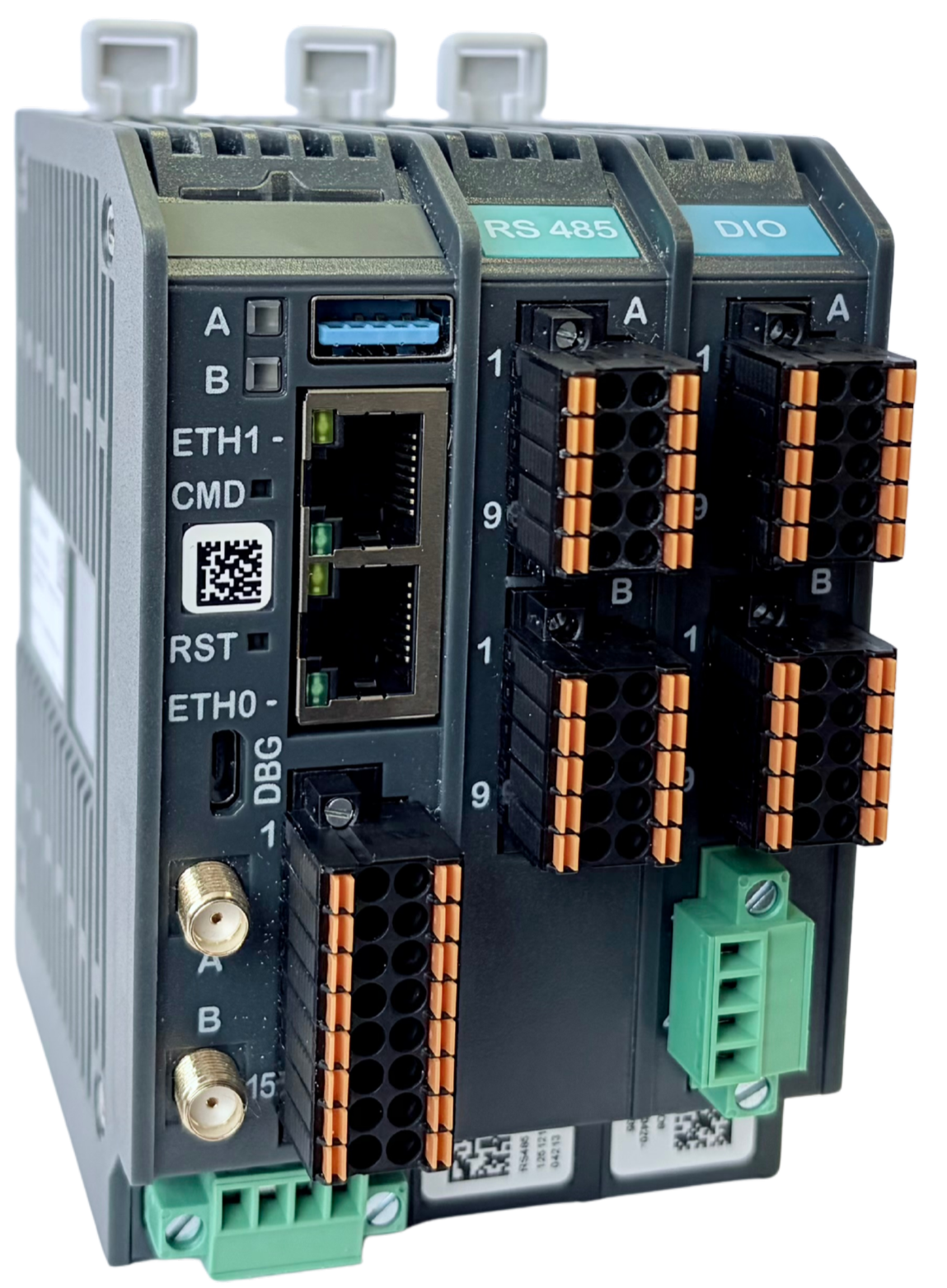
The modular design of the control unit allows it to be flexibly adapted to the requirements of various industrial applications. The system can be easily customized with digital I/O modules and communication interfaces, thus always offering an optimized solution for the task at hand.
The device complies with industrial EMC standards, ensuring a high level of interference immunity against electromagnetic effects and network disturbances. This makes it reliable for use in industrial environments where continuous operation and stable data connections are essential requirements. Thanks to its DIN rail mountable design, it can be easily integrated into existing cabinets and industrial infrastructures. Its long-term availability and scalability make it the ideal choice for projects where flexibility, operational reliability, and cost-effectiveness are all important considerations.
2 Ethernet interfaces - separate Internet and intranet
The control unit has two separate Ethernet ports, which allow the Internet and intranetnetworks to be separated. One port provides internet connectivity – for example, for remote monitoring, data transmission, or access to cloud services. If required, controlled devices can also be connected to this network, giving them direct internet access for their own monitoring systems or software updates.
The other port, on the other hand, allows for the creation of a separate, protected internal network (intranet). When controlled devices are connected here, they do not have Internet access, which ensures a higher level of security. This is particularly advantageous in industrial environments where network policies strictly limit Internet access to internal systems.
Separating the two ports thus guarantees secure and uninterrupted local control, while maintaining flexibility for providing Internet access as needed.
RS-485 interface – for integrating older devices
The RS-485 interface of the control unit also allows you to manage devices that do not yet support Modbus TCP communication. For example, older inverters or other industrial devices can be easily integrated into the system via the Modbus RTU protocol, ensuring compatibility and long-term operation even in mixed infrastructures.
Digital IO module - direct control and status monitoring
The digital I/O module enables direct control of various industrial devices and status feedback. The inputs and outputs, which operate at a signal level of 24 V, ensure simple and reliable integration into control cabinets, safety elements, or dedicated consumers.
Using logic based on I/O signals, the system can control automated processes, such as starting a hot water production unit or a cooling compressor in the event of excess solar energy. It is also suitable for switching motor circuit breakers on and off and providing feedback on their current status.